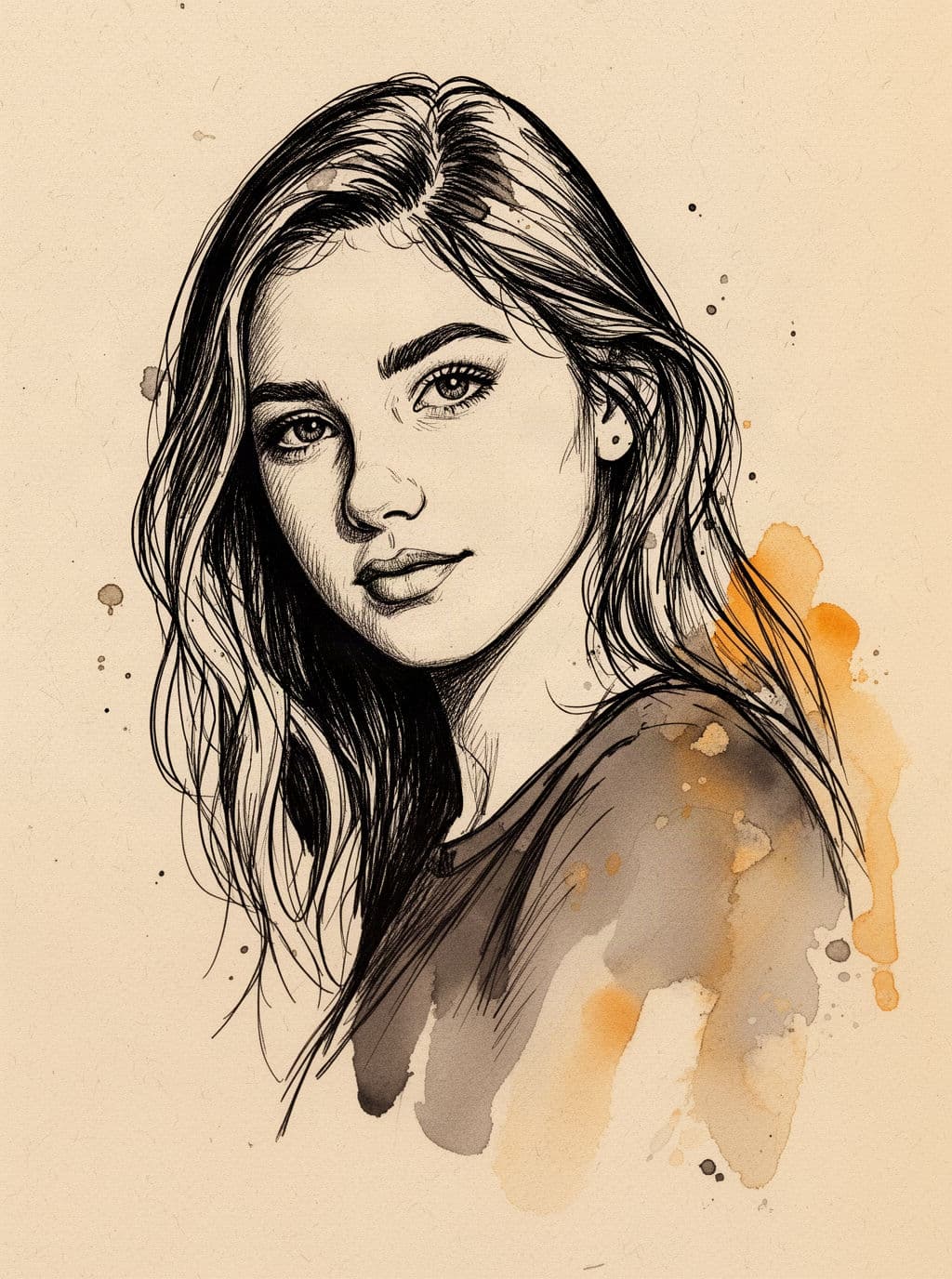
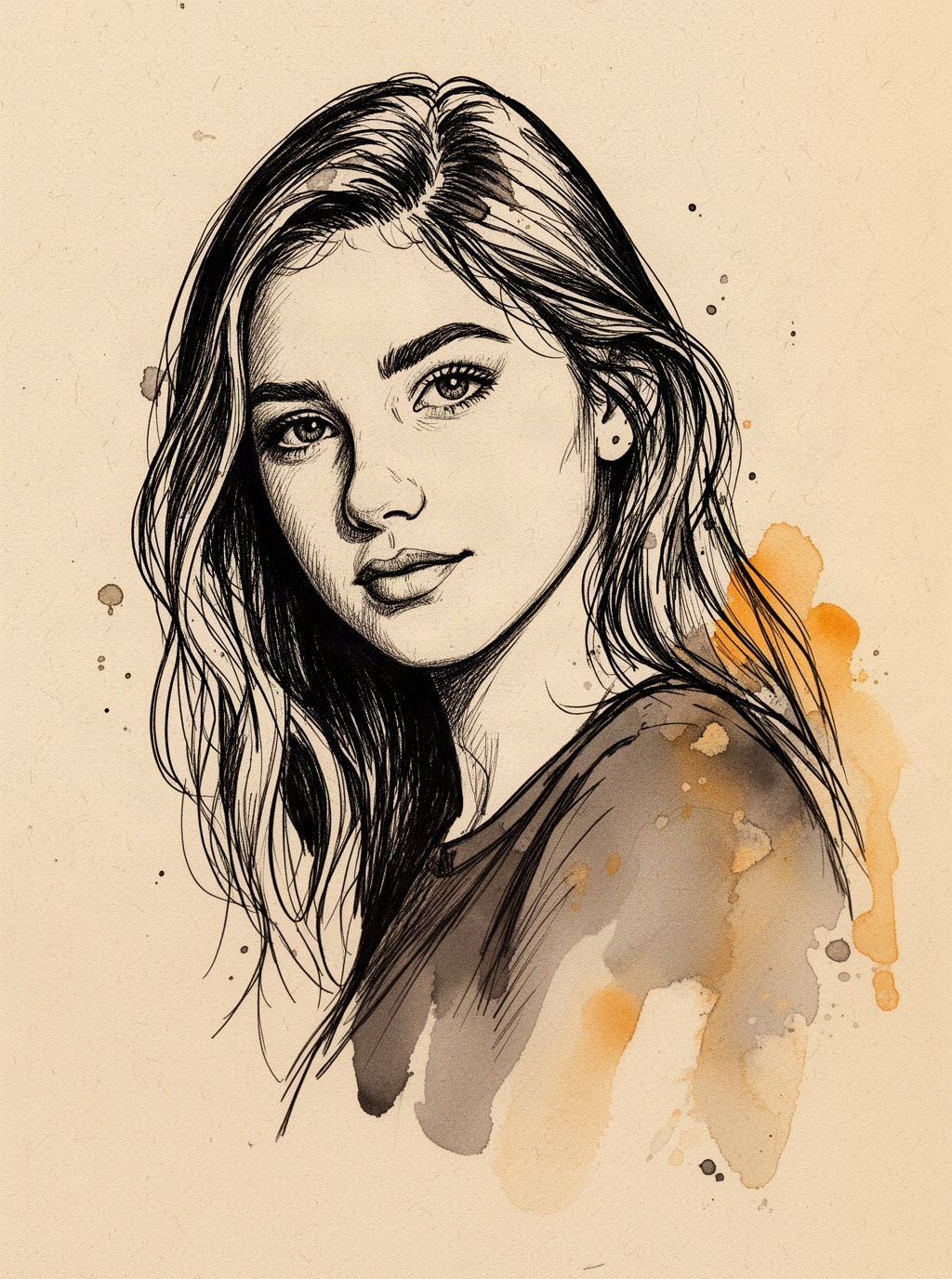
Redraw the uploaded photo as a hand-inked sketchbook portrait illustration, executed in confident pen linework with loose watercolor accents. Preserve the subject's exact identity, facial features, expression, head angle, pose, framing and any signature details — hair shape, glasses, earrings, clothing silhouette — converting only the rendering technique, never the person.
Render the entire image as original artwork, not a photo filter. Lay down expressive black-ink contour lines with natural weight variation: bold, slightly tremulous strokes around the outer silhouette and the dark masses of hair, fine delicate lines across the facial features. Build all form and shadow through hatching and cross-hatching rather than smooth gradients — pack dense diagonal pen strokes into the recesses (under the chin, the neck, the eye sockets, the inner hair) while leaving the lit planes of skin as bare, untouched paper. Treat hair as directional bundles of strand lines broken by solid saturated black passages and paper-white highlight gaps. Draw the eyes with crisp outlines, hatched irises and individually inked lashes so the gaze stays recognizable and alive.
Set the figure against a warm aged-paper field, a soft cream tone around #f1e4c9, carrying faint fiber speckle and a few stray flecks; remove any photographic background so the portrait floats on this clean page. Layer transparent watercolor washes only partially over the drawing — a muted warm taupe-grey (about #6f6058) pooled loosely across the clothing and shoulders, and a single soft golden-amber bleed (about #dd9c3c) running off one side of the body, complete with watercolor edge-darkening, feathered wet margins and irregular blooming stains. Let the washes stray past the ink contours and let the linework read clearly through them; color should accent the drawing, never bury it.
Scatter small ink droplets and spatter dots in dark sepia and amber around the outer edges of the figure, like accidental flecks on a working sketchbook page, with a couple of larger blotches for balance. Keep the finish tactile: visible paper grain, dry-brush texture in the washes, and honest hand-made imperfection in the line pressure, while the ink strokes stay razor-sharp against the soft, wet-looking color.
Mood: an intimate, expressive artist's sketchbook study — editorial illustration quality, refined but unpolished.
Avoid: flat vector-style outlines, smooth digital airbrush shading, fully opaque color fill that hides the linework, muddy or over-saturated washes, perfectly symmetrical clean edges, plastic smoothed skin, and any drift away from the subject's true likeness.