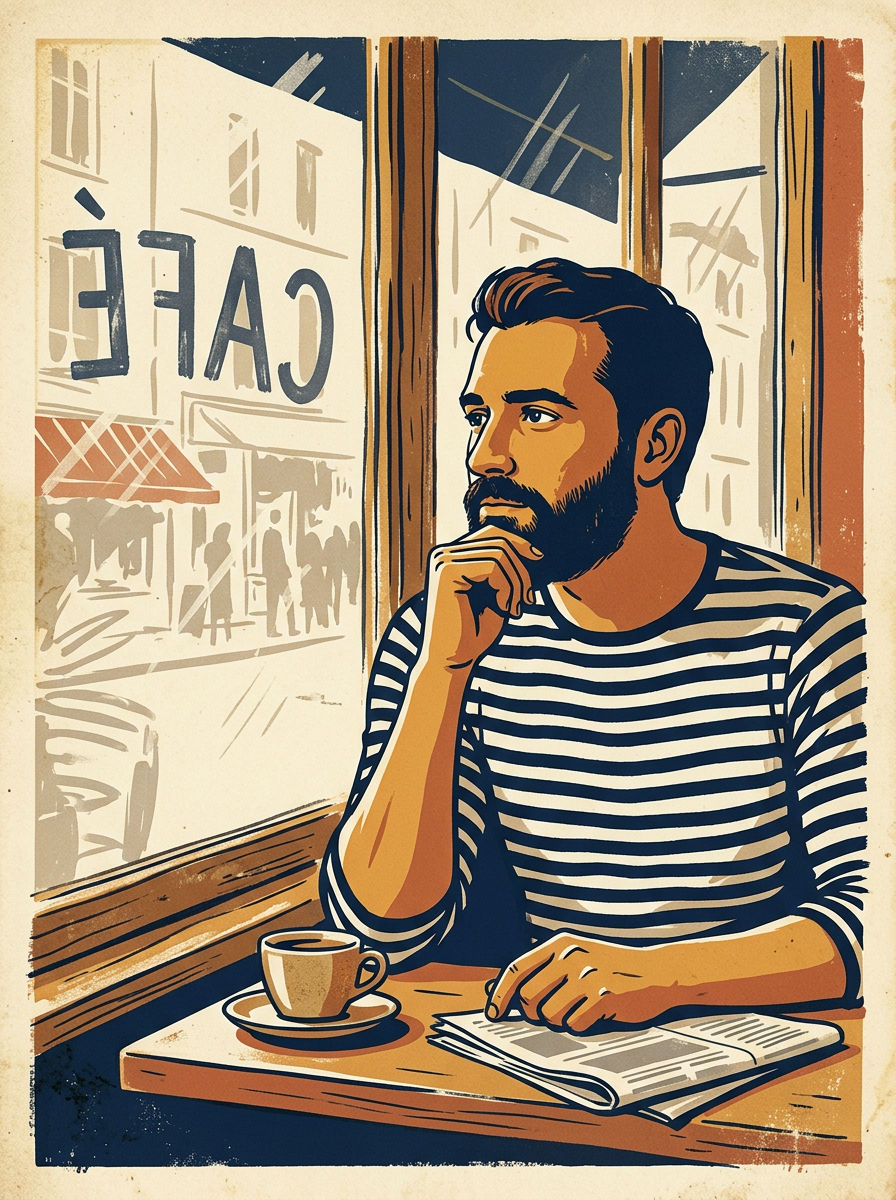
Reimagine the uploaded photo as a hand-inked vintage travel-poster illustration, the kind printed for a mid-century café magazine. Preserve the subject's identity, pose, facial structure, wardrobe shapes and overall composition exactly — what changes is the rendering, not the person or the scene. Every element, from face and hands to clothing, props and background, should be flattened and simplified into a clean editorial drawing.
Reduce the whole image to a strict limited palette: warm terracotta ochre (#C26A3A) and amber (#D98E4A) for skin and lit surfaces, deep inky navy (#1F2A44) for shadows, hair and line work, soft cream (#F1E6D0) for highlights and the paper base, and a muted slate-tan (#9A8E7C) for mid-tone background shapes. No realistic color, no smooth photographic gradients — color is applied in flat, hard-edged blocks with only two or three tonal steps per form, so a cheek reads as one warm shape beside one cool shadow shape.
Draw confident dark ink contours around every silhouette and internal feature — eyes, brow, jaw, fingers, seams, object edges — with slightly uneven, hand-ruled line weight, the navy lines a touch rough and organic rather than vector-perfect. Fill the enclosed shapes with the flat palette above, letting cream paper show through as the lightest tone. Treat patterns on clothing and textures in the background as simplified graphic marks, not photographic detail.
Finish the surface like a worn offset print on aged stock: lay a fine paper-fiber grain over the entire image, add faint screen-print halftone dot structure in the mid-tones, a hint of ink misregistration where color blocks meet the outline, and scattered foxing speckles and soiling concentrated at the corners. Frame the result with a narrow cream margin and softly deckled, discolored edges so it reads as a physical poster card resting on a table.
Mood: nostalgic, sun-warmed, collectible — a printed souvenir from a bygone travel brochure. Crisp graphic edges, deliberate flatness, tactile paper character, gallery-print quality.
Avoid: photorealistic skin or smooth airbrushed gradients; neon or saturated modern colors; cartoonish rubbery outlines; messy watercolor bleed; digital-clean vector look with no texture; distortion of the subject's face, pose or proportions; loss of recognizable identity.